As the world turns to nature-based solutions to accelerate the phasing out of fossil fuels, bioenergy – energy derived from organic materials – is being increasingly proposed as a cost-effective, renewable and low emissions alternative. New climate targets from heavily polluting industries such as aviation, heating and electricity, and international shipping have already ramped up the demand for cleaner energy and biofuels – fuels made from organic sources like food crops, wood and organic waste - keep gaining greater attention.
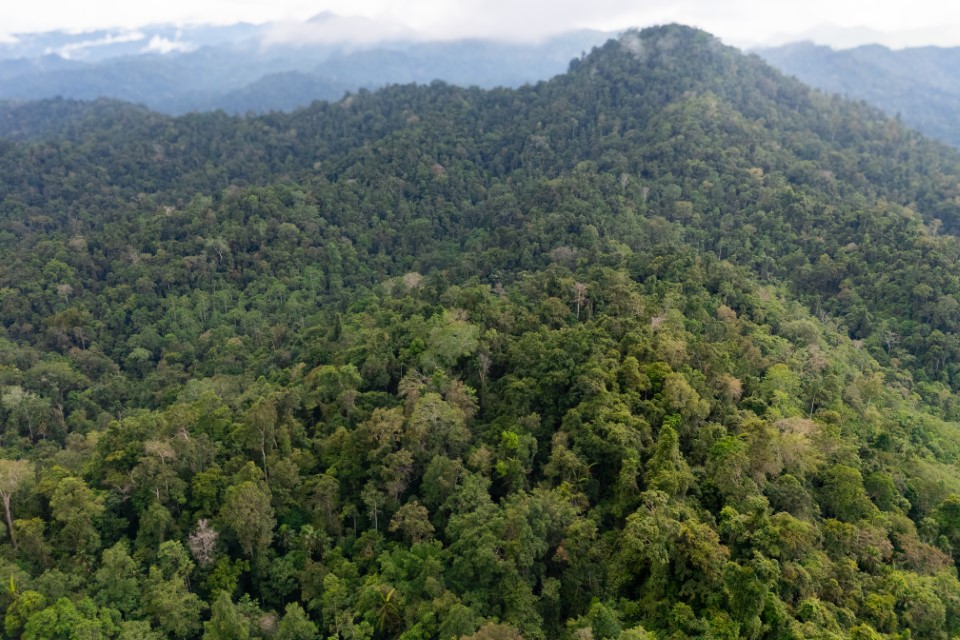
This explosion, however, has not come without consequences. Like biomass, as the demand for biofuels increases, so does the environmental impact. Biofuel production requires large feedstocks, and thus, extensive amounts of arable land often portrayed as "marginal" or “unused” but which, in reality, serve as the basis of livelihoods for small farmers and Indigenous Peoples, carbon sinks and biodiversity hubs. For crop-based biofuel feedstocks like soy and palm oil, meeting rising demand comes with significant deforestation and land use change risks, as more and more natural forest cover is cleared to make way for large-scale monocrop plantations.
Forests, which cover around 32% of the Earth’s land surface, provide vital ecosystem services supporting food systems, powering industries and maintaining a stable global climate. Beyond market products like timber and non-wood forests products (NWFPs), forests drive and sustain the economy, create jobs, enable food security and provide homes and livelihoods for over 1.6 billion people around the world, including Indigenous peoples and local communities (IPLCs). Yet, despite generating immense ecological and social value, investment in forests’ protection is woefully insufficient. The UNEP’s latest State of Finance for Nature report estimates that for every $1 spent on protecting nature, $30 is spent on its destruction – including biofuels-driven deforestation.
Each year on March 21, we recognize International Day of Forests – a day meant to spotlight forests’ invaluable contributions to both people and the planet. This year, the UN Food and Agriculture Organization (FAO) has selected the theme “Forests and Economies”, centering forests in its promotion of an emerging bioeconomy where “wood and bamboo can be used as renewable replacements for carbon-intensive materials” and “woodfuel such as pellets are used at an industrial scale for power and heat applications”. Though well-intentioned, this messaging inadvertently reinforces a potentially threatening narrative that treats forests as mere feedstocks waiting to be harvested for energy and industrial use, rather than precious resources to be conserved and protected.
With rising demand potentially putting an estimated 7 million hectares of forests at risk of being partially or fully destroyed by 2030, messages like the FAO’s, alongside widely touted narratives about the “sustainable” nature of biofuels, are increasingly being questioned. In this special International Day of Forests edition of Explained, we discuss why, highlighting how global industrial decarbonization efforts are risking some of the planet’s last remaining defenses against climate change.
Forests: The Foundation of Life
Forests are far more than simple collections of trees; they are complex living systems connecting flora, fauna, fungi, microorganisms, water cycles, soils, and climate in an intricate web of life.
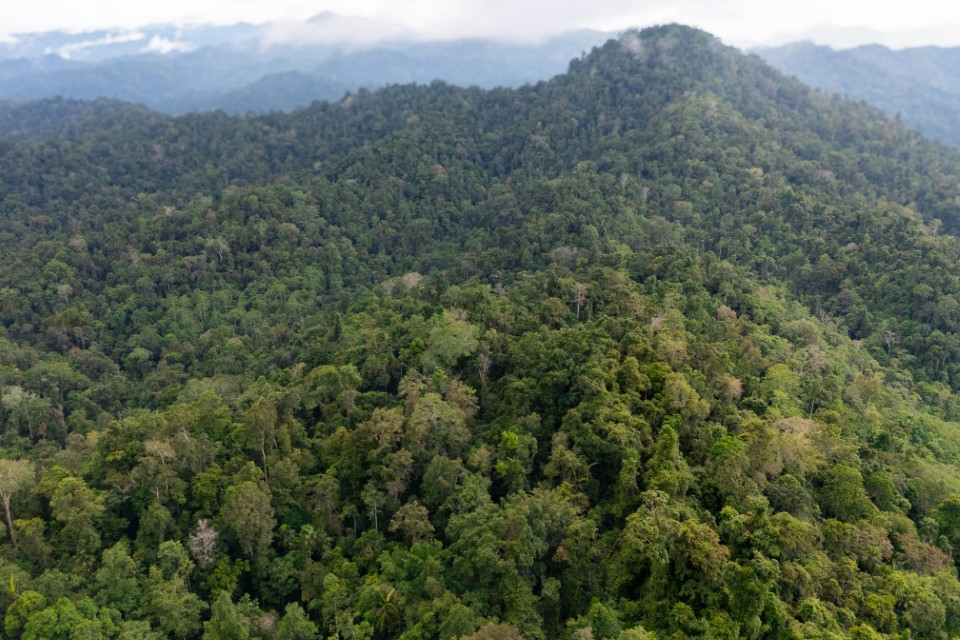
Forests capture and store carbon, manage river systems, maintain local water supplies, and buffer against extreme weather events, reducing disaster risks. In particular, tropical rainforests, which make up around 45% of global forest cover, play a significant part in maintaining global water cycles by regulating regional and global rainfall patterns, generating atmospheric moisture and helping stabilize the climate.
They are also often home to peatlands, waterlogged ecosystems which delay the decomposition of vegetation like deadwood and leaf litter, leaving behind peat. These are some of the most biodiverse, carbon-rich ecosystems on Earth, storing almost twice as much carbon than all the world’s forests combined. When these massive, long-term carbon sinks are drained for purposes like biofuel feedstock plantations, peat is exposed to oxygen, triggering the continuous release of greenhouse gases like CO2 and methane. According to the UNEP, around 4% of global annual GHG emissions come from degraded peatlands, making potential biofuel demand growth a very real threat.
Biofuels: A Crash Course
You’ve probably heard of ethanol, biodiesel, maybe even biogas. These are all examples of biofuels. These are the liquid/gaseous end products of organic materials processed to produce low-carbon fuels for energy-intensive industries like air and road transportation, maritime shipping and electricity generation. Biofuels come in several different camps, but the most prevalent types are crop-based or “first generation” biofuels (like those derived from food crops like soy, corn, and the oil palm) and “second generation” biofuels, which are made from non-food residues and waste products including used cooking oil (UCO), animal fats and derivatives like palm fatty acid distillate (PFAD) and palm oil mill effluent (POME).
First-gen or “conventional” biofuels are typically processed through fermentation and similar chemical processes which convert the oils, sugars and fats in feedstock materials into bioethanol or biodiesel. Methods of producing second-gen biofuels vary by feedstock. Some, like palm derivatives, undergo a process similar to that of first-gen feedstocks, while others like wood turn raw materials into a final product through gasification or hydrolysis.
Biofuels: Renewable in Name, Risky in Practice
Biofuels are frequently portrayed as renewable, sustainable form of energy because their feedstocks – that is, the source materials – are often cheaply sourced and easy to replenish within a short period, allowing for regrowth and continuous harvesting. On closer inspection, though, these claims of sustainability start to fall apart, especially when the environmental costs of producing these cheap feedstocks at industrial scale are considered.
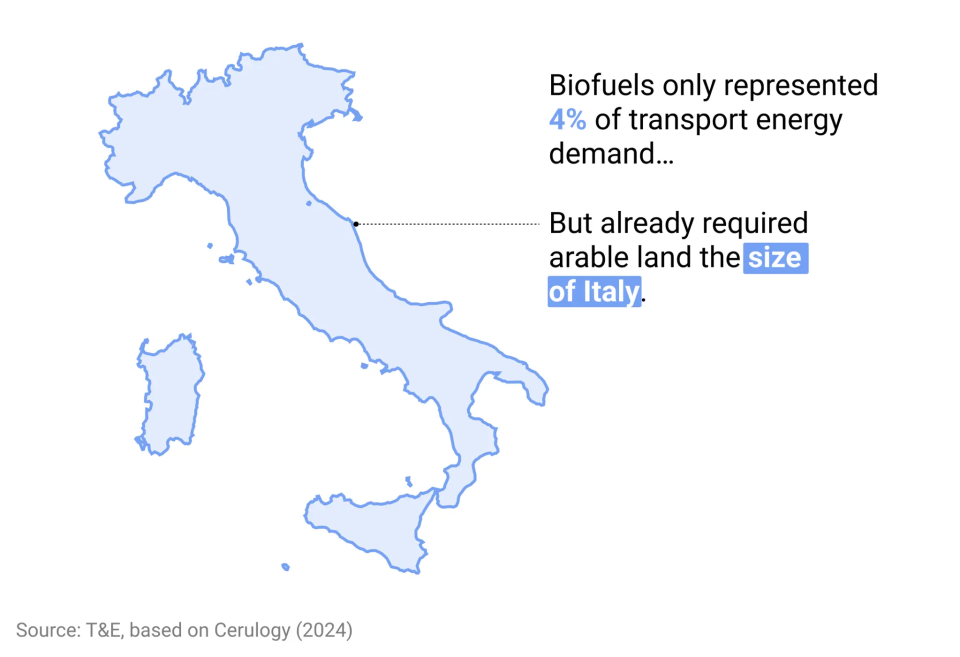
Crop-based biofuels require massive feedstocks – and thus extensive amounts of arable land – meaning they often both take over land that would otherwise be used for food production and encroach on natural forests. In 2024, global biofuel demand required around 32 million hectares of arable land – almost the size of Italy – a figure set to grow by 60% to 52 million hectares by the year 2030, roughly equivalent to the size of France.
First-gen biofuel production comes with significant risks of Indirect Land Use Change (ILUC) – how we measure the impact of biofuel feedstock expansion on forests and land. As demand rises, forests risk being converted into large-scale monocrop plantations which release carbon, accelerate biodiversity loss and wildlife habitats and often displace local Indigenous communities. This land conversion can lead to additional GHG emissions that are often omitted in the biofuel industry’s carbon accounting calculations. This is especially true of palm oil and soy.
Biofuels in Focus: Palm Oil and its Derivatives
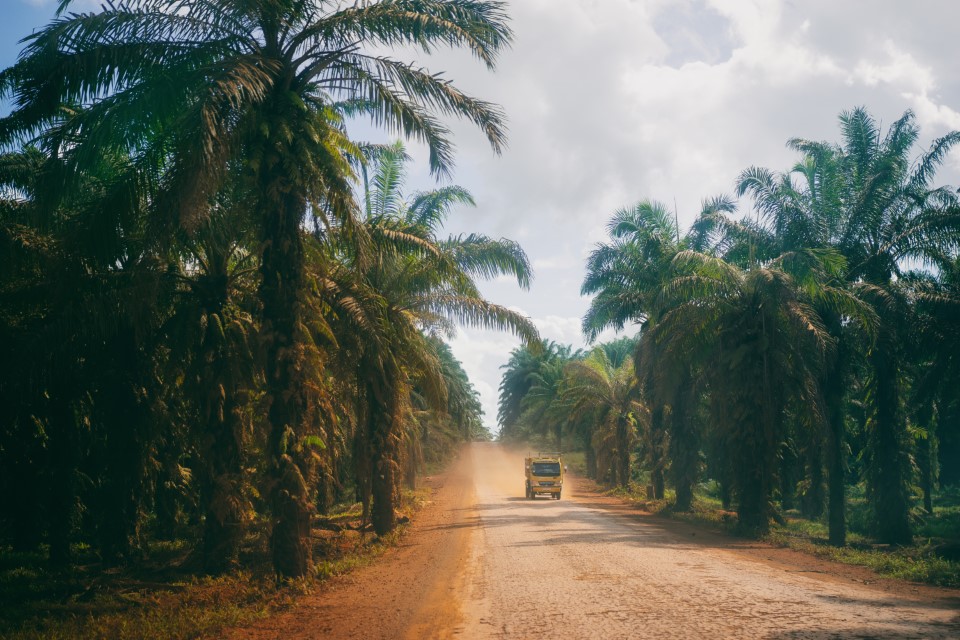
Palm oil is one of the most widely traded vegetable oils globally and a major feedstock for biodiesel due to its high yield and low production costs. Indonesia and Malaysia accounted for around 86% of global palm oil production in 2025, producing a combined 67 million tons. Because of its geographical concentration, palm oil production has proven to be a significant driver of deforestation across Southeast Asia. Much of recent oil palm expansion in the region has taken place on tropical peatlands, which when drained are more susceptible to burning, therefore releasing enormous quantities of smoke and emissions while destroying surrounding forest cover.
On the Indonesian island of Borneo, palm oil concessions have destroyed the habitats of species like the critically endangered Bornean orangutan and led to allegations of land grabbing in customary Indigenous lands.

Palm oil derivatives like Palm Fatty Acid Distillate (PFAD) and Palm Oil Mill Effluent (POME) are emerging as leading feedstocks for biodiesel production. This growth is propelled by their supposed alignment with the concept of the circular economy, which, in principle, seeks to reduce environmental harm by using true waste without creating new upstream demand for primary production. The reality, however, is more complex, with these claims inadvertently masking growing deforestation pressures.
PFAD is commercially valuable and actively traded. When demand for PFAD increases due to biofuel mandates, sustainable aviation fuels (SAFs) or shipping decarbonization policies, it risks reinforcing overall demand for palm oil. Similarly, the increasing use of POME as a biofuel feedstock has been colored by numerous investigations revealing materials labeled as POME biofuels were in fact conventional palm oil disguised as waste.
While biodiesel is often framed as a low-carbon alternative to fossil diesel, the climate equation changes dramatically if forests or peatlands are converted to grow feedstock. When the math factors in deforestation and land use impacts, it turns out palm oil-derived biodiesel can emit up to three times more CO₂ than its fossil-fuel derived counterpart.
Leakage Markets: How Biofuel-Driven Deforestation Slips Through the Cracks
In 2019, the European Union (EU) classified palm oil as a high ILUC-risk feedstock under its Renewable Energy Directive (RED II and RED III), and has begun the process of phasing out its usage in achieving renewable energy targets.
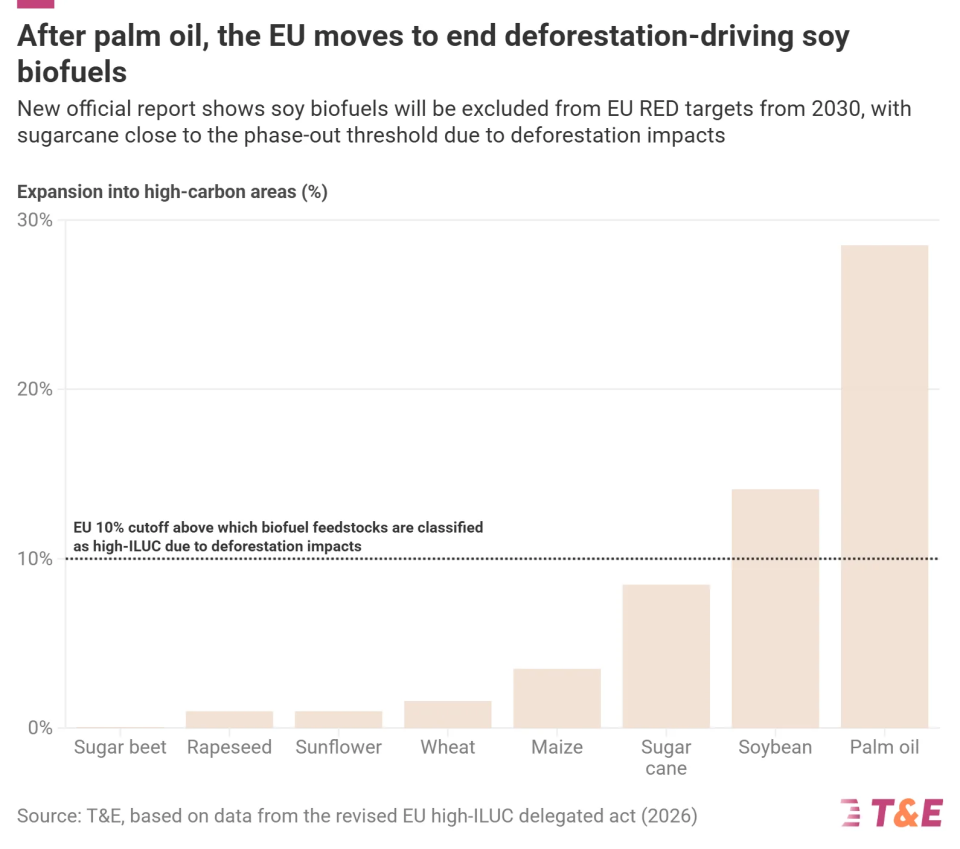
Safeguards in one part of the world, however, don’t eliminate the environmental risks of a heavily import-driven industry where biofuel feedstocks are being exported in growing quantities to other regions with weaker sustainability criteria, creating what we call leakage markets.
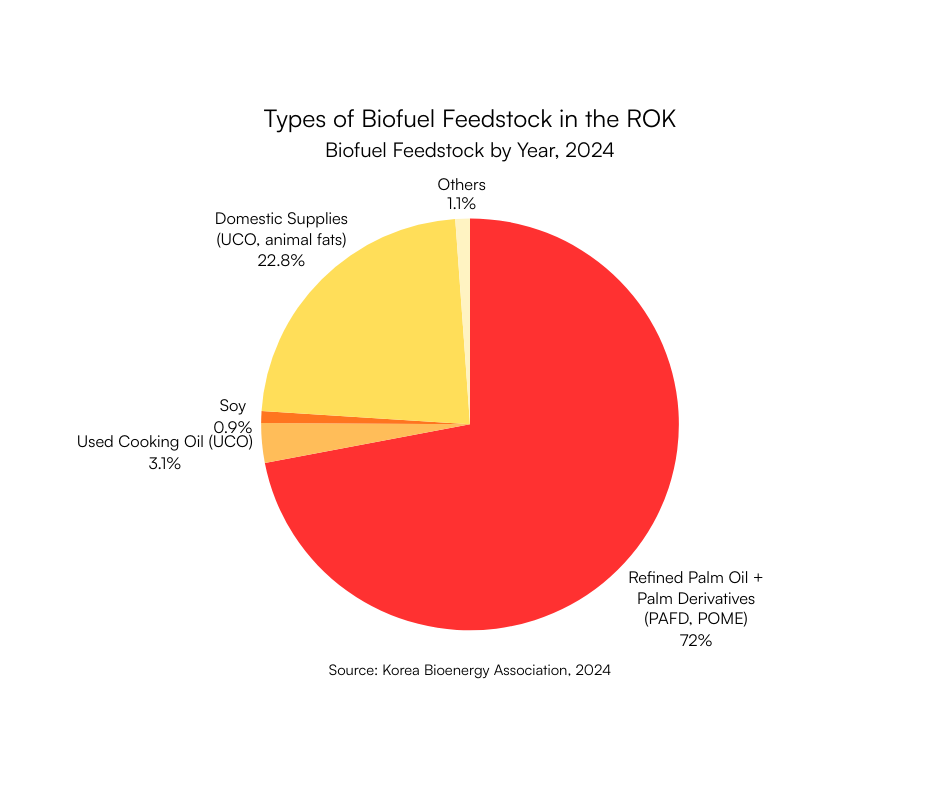
In East Asia for example, countries like Japan and South Korea are increasingly reliant on biomass and biofuels for energy and transportation. In 2024, palm oil-based feedstocks accounted for 72% of South Korea’s biodiesel production. Because domestic resources are limited, importer countries depend heavily on feedstocks from Southeast Asia, often with little to no regulatory mechanisms in place to ensure deforestation and land use change risks are sufficiently mitigated. Growing demand from leakage markets like these absorb the palm oil and related products redirected away from the EU, inevitably maintaining pressure on tropical forests in producer countries.
The Potential Costs of Unchecked Biofuels Expansion
Global liquid biofuel production has increased by more than six times in the last two decades. Combined with biomass, bioenergy sources now account for more than 55% of global renewable energy supply. As countries seek to accelerate the decarbonization of hard-to-abate industries like aviation and international shipping, it is critical that proper regulatory safeguards are put in place at both the domestic and international levels to ensure energy transition does not occur at the expense of the world’s already at-risk forest ecosystems.
Brazil launched the Belém x4 Pledge on Sustainable Fuels at COP30 last November, endorsed by Japan, Italy, India and others. The new pledge is a commitment to quadrupling the production and use of “sustainable” fuels – specifically hydrogen, biogases, biofuels and e-fuels – by 2035. According to the International Energy Agency (IEA), this increase would mean more than doubling the global use of biofuels. And based on current trends, studies project that 90% of biofuels will still be reliant on food crops and commodity feedstocks by 2030.
By now, it should be pretty clear why that might be a problem. The numbers suggest a high-demand scenario, primarily driven by the aviation industry, could see up to 11.5 billion tons of CO2 released into the atmosphere from biofuel production alone. Accounting for the impacts of deforestation, peatland loss and land use change, by 2030, biofuels will emit 70 million tons of CO2e more annually than the fossil fuels they were designed to replace – the equivalent of almost 30 million diesel cars’ worth of emissions.
What’s Driving Biofuel Expansion?
Industrial decarbonization pressures play a major role in the growing demand for crop-based biofuel expansion. Governments use a variety of policy instruments including subsidies and blending mandates to create sustained market demand for non-fossil fuels in the aviation, road transport and shipping sectors.
Mandates like the Carbon Offsetting and Reduction Scheme for International Aviation (CORSIA) include crop-based feedstocks like palm oil, soy and corn as “main products” under their sustainable aviation fuels (SAFs) list. In South Korea, the road transport blending mandate currently sits at 4%, and is expected to double by the end of the decade. On the aviation side, the country will scale up the SAF blending mandate ratio from 1% in 2027 to 3–5% in 2030 and 7–10% in 2035.
T&E estimates that under the International Maritime Organization’s Net Zero Framework, nearly a third of global shipping could run on biofuels by 2030, with two-thirds of that potentially coming from palm oil and soy. Given its commercial readiness and compatibility with conventional vessels, biodiesel is likely to see the greatest demand in the early push for maritime decarbonization. In Singapore, for example, biofuel bunkering volumes jumped from 0.88 million tons to 1.36 million tons between 2024 and 2025, a 54% on-year increase.
In Korea, biofuel blending mandates are yet to be implemented in the maritime shipping sector, reflecting broader uncertainty ahead of this April’s IMO-MEPC 84 negotiations where biofuel standards will be a key agenda item.
A Make-or-Break Moment for Forests
The sustainability of biofuel expansion will be a major conversation point in numerous international forums in the coming months. Discussions at the IMO this April will set the tone for biofuel sustainability criteria assessment in the shipping industry, determining whether decarbonization targets will inadvertently increase demand for crop-based (especially palm oil) biofuel feedstocks. Biofuels will certainly feature on the agenda of the upcoming inaugural Transition Away from Fossil Fuels (TAFF) conference, a new counterspace meant to make progress on global fossil fuel phaseout where procedural deadlocks have weakened the UN climate arena. Eyes will also be on the COP30 President’s informal Roadmap on Halting and Reversing Deforestation and Forest Degradation by 2030, to see whether competing energy and decarbonization priorities will undermine its aims to protect and restore the world’s remaining forest cover.
Throughout all these conversations, the call for robust, effective safeguards against biofuel-driven deforestation and land use change must be a loud one. Forthcoming biofuel standards, policies and regulations must apply rigorous lifecycle accounting, ensure traceability of residues and by-products, and fully respect Indigenous land rights. In the best-case scenario, this means excluding high ILUC-risk feedstocks like palm oil and soy, two of the cheapest and most convenient feedstocks to produce at scale.
The credibility of these discussions and their outcomes will depend on a seemingly simple choice: whether governments and their energy and trade policies will reinforce, rather than contradict, public commitments to protecting forests.
International Day of Forests gives us a chance to reflect on what may seem like a difficult truth: forests aren’t fuel. They are invaluable, incredibly biodiverse ecosystems which play an extremely underrated role in maintaining life as we know it. Decarbonization efforts that come at their expense are bound to both figuratively and literally backfire.
Countries now sit at a crossroads where their next moves could make-or-break the future of not just our forests and all those who live in and depend on them, but the future of our planet as a whole.
Here’s to hoping they make the right ones.
Related insights

No Empty Space in the Forest
Reflections from the 2026 Japan-Indonesia Forest Conservation Symposium
2026-08-05
Certifying the Unsustainable: Debunking the Sustainable Biomass Program (SBP)
“Sustainable” biomass scheme greenlights deforestation, new report finds
2025-07-31

Fake Solutions, Real Consequences: Why We Must Save our Forests
International Day of Forests, March 21
2025-03-21

Burning forests, boiling climate: Woody biomass harms global biodiversity
2024-08-06


