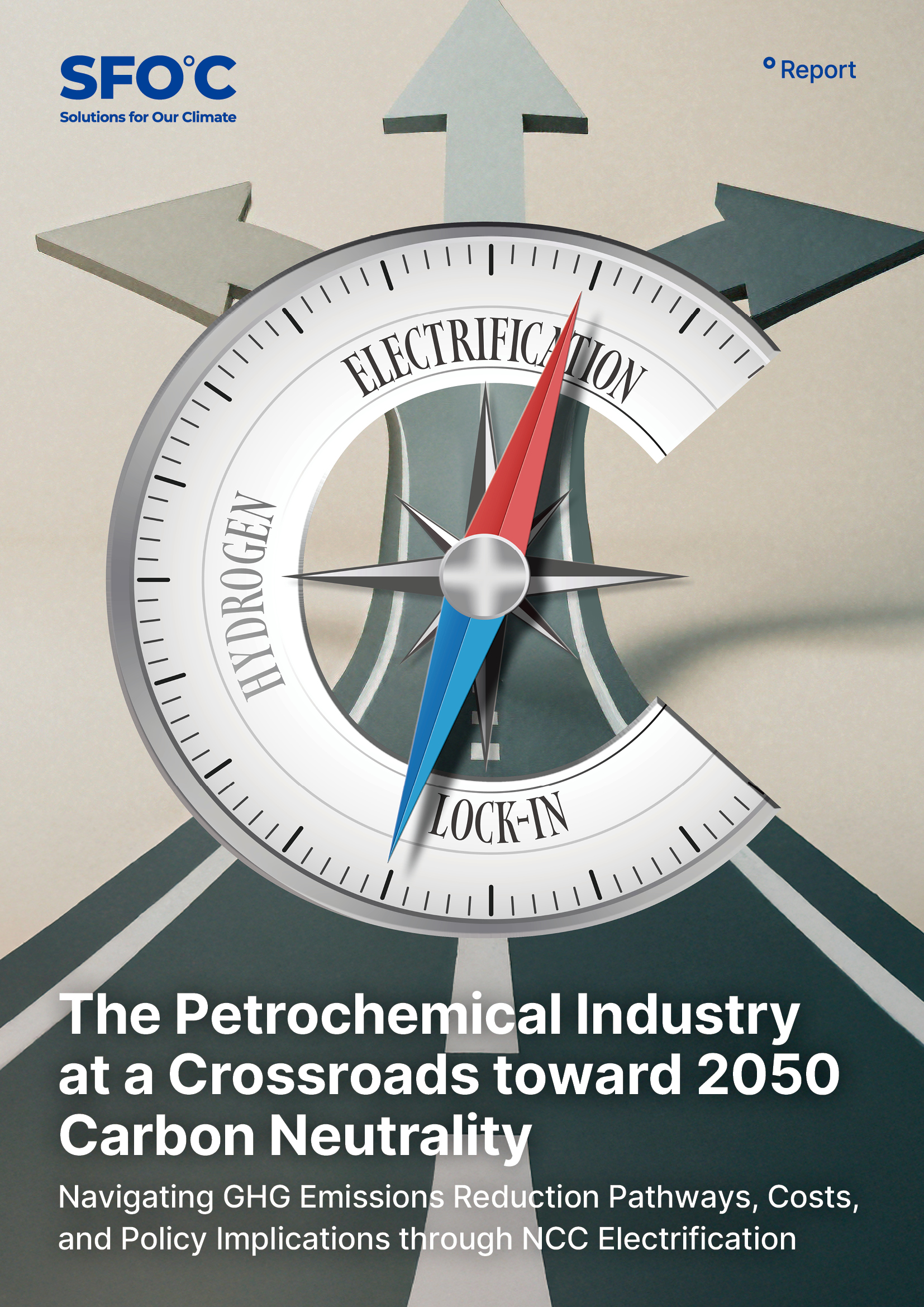
The Petrochemical Industry at a Crossroads toward 2050 Carbon Neutrality: Navigating GHG Emissions Reduction Pathways, Costs, and Policy Implications through NCC Electrification

About
The petrochemical industry is one of the core industrial sectors in Korea that emits a substantial share of greenhouse gases, and it is currently facing a dual challenge: an industry-wide crisis driven by global oversupply and mounting pressure to transition toward decarbonization. In particular, naphtha cracking centers (NCCs), which account for approximately 70% of emissions from the petrochemical sector, represent a critical process that must undergo transformation to achieve carbon neutrality by 2050.
This report demonstrates that, among NCC fuel transition options, NCC electrification is a more cost-effective decarbonization pathway than alternative fuel-transition options, including hydrogen-based technologies. It provides a quantitative analysis of the technological and economic pathways through which Korea’s petrochemical industry can achieve carbon neutrality by 2050. Focusing on major petrochemical industrial clusters—Yeosu, Ulsan, and Daesan—the report compares abatement costs and electricity demand and comprehensively assesses the cost-effectiveness of NCC electrification versus hydrogen-based pathways, as well as the impacts of industrial restructuring, including production capacity reductions. Based on these findings, the report presents policy and financial support measures needed to accelerate the demonstration and commercialization of NCC electrification.
Executive summary
This study quantitatively evaluates the feasibility of achieving carbon neutrality in Korea’s petrochemical industry by 2050 by comparing and combining key transition technologies, including NCC electrification, NCC hydrogenization, heat pumps, and low-carbon technologies for high-temperature BTX processes.
The analysis finds that, in the context of NCC fuel switching, NCC electrification using renewable electricity is a cost-effective decarbonization option for the petrochemical industry.
In particular, when combined with industrial restructuring that includes a 25% reduction in production capacity, NCC electrification is estimated to deliver cumulative cost savings of up to KRW 128 trillion compared to hydrogen-based alternatives.
While domestic NCC electrification technologies remain largely at the experimental stage, major international companies have already advanced to the construction and operation of demonstration plants using electrically heated cracking furnaces, highlighting a growing gap between Korea’s domestic industry and global front-runners.
Based on these findings, the study clearly demonstrates that accelerated demonstration and commercialization of NCC electrification will require strong policy and financial support from the government, alongside expanded renewable energy infrastructure.
Grounded in quantitative analysis, this report presents a decarbonization pathway for the petrochemical industry that combines technological transition with production restructuring, and offers policy implications to support its practical implementation.