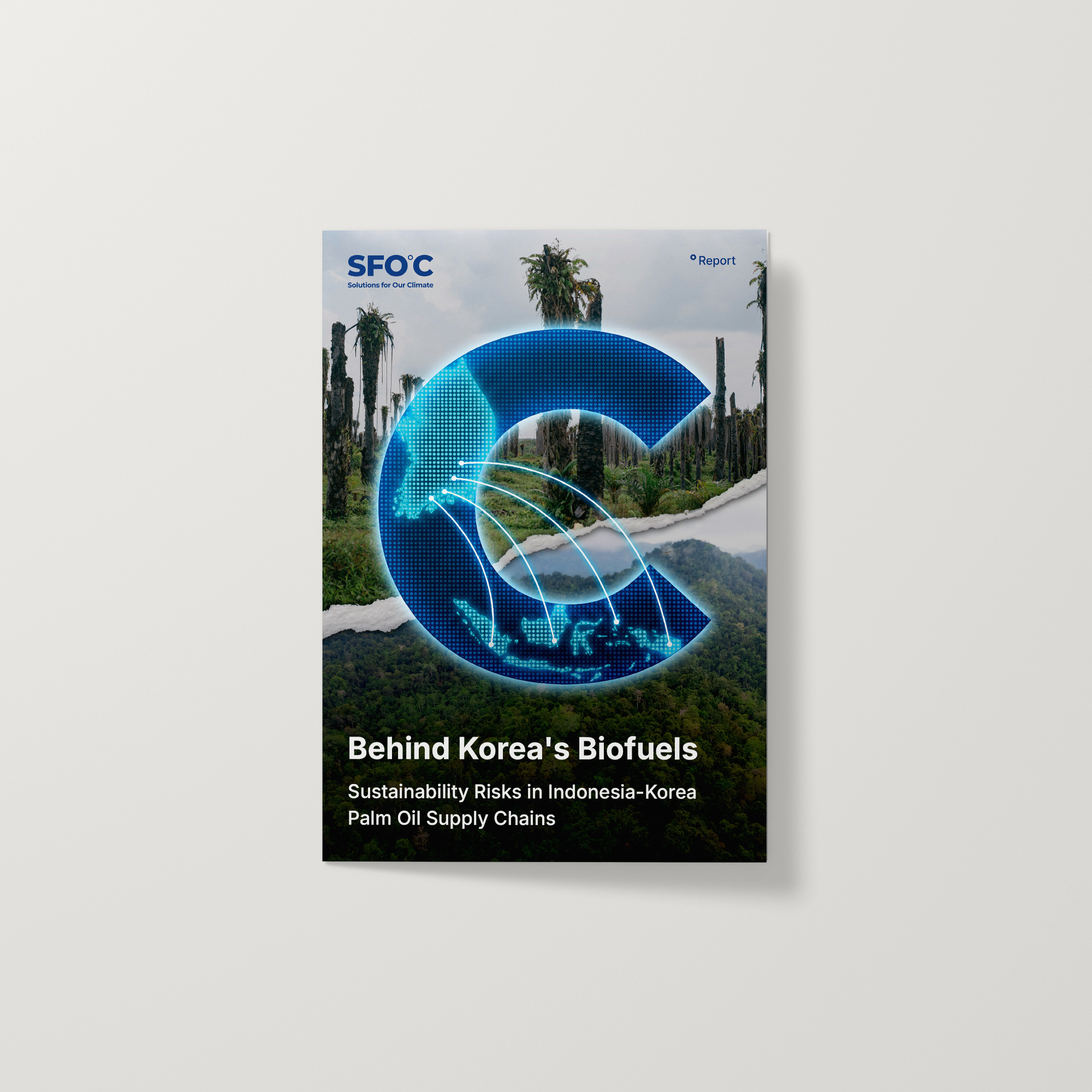
Behind Korea’s Biofuels: Sustainability Risks in Indonesia–Korea Palm Oil Supply Chains


About
This report examines the Indonesia–South Korea palm-based biodiesel supply chain. It analyzes trade trends, key corporate actors, and their links to documented environmental and social risks, highlighting South Korea’s exposure to deforestation-linked feedstocks in the absence of sustainability safeguards. This leaves the Korean biofuel supply chains remain vulnerable to deforestation-linked feedstocks and broader environmental and social harms associated with the Indonesian palm oil sector.
Download report
Executive summary
South Korea’s biofuel sector is increasingly reliant on Indonesian palm oil, which is linked to deforestation, peat degradation, land conflicts, corruption, and legality issues. Existing certifications and voluntary commitments have not translated into consistent outcomes on the ground, partly because they focus on individual companies rather than broader landscape-level impacts. This shifts responsibility onto producer countries and leaves Korean end-users exposed to environmental, social, and emissions risks.
As international standards tighten South Korea risks becoming a “leakage market” for high-risk products. Without stronger demand-side safeguards, its biofuel consumption could undermine climate and biodiversity goals and reinforce deforestation-linked supply chains.
Recommendations
Government
Require full life-cycle assessment (LCA): Given the international recognition of LCA in addressing the climate crisis, biodiversity loss, and pollution, the government must establish comprehensive LCA-based criteria for biofuels. The greenhouse gas (GHG) emissions assessment must address supply chain emissions, including indirect land-use change. Implementing full LCA standards is the first step to ensure avoiding and phasing out high-risk, high-impact feedstocks.
Adopt stringent sustainability criteria: The government must introduce sustainability criteria for biofuels based on standards including, but not limited to, lifecycle GHG emissions, biodiversity impacts, and human rights considerations, in alignment with international climate and biodiversity protection commitments. Compliance must be verified through strong supply chain due diligence, with ineligible feedstocks excluded from counting toward renewable energy targets.
Introduce supply chain due diligence regulation: The government must establish mandatory regulations for corporations and financial institutions to conduct environmental and human rights due diligence across their biofuel supply chain. This regulatory framework should include grievance and remedy mechanisms and allow only the products verified as ‘deforestation-free’ to enter the market. Reducing the forest footprint embedded in supply chains would strengthen South Korea's commitments on decarbonization and biodiversity protection.
Corporations
Commit to a deforestation-free supply chain: Companies involved in palm oil supply chains must declare and implement time-bound No Deforestation, No Peat, and No Exploitation (NDPE) policy. These commitments must apply across the entire supply chain, with strong monitoring and exclusion policies for suppliers with links to harmful practices, such as deforestation, human rights violations, corruption, and illegality.
Implement human rights and environmental due diligence: Given weak enforcement and persistent controversies associated with certified suppliers, companies must enhance supply chain-wide due diligence, rather than continuing to rely on self-reporting and voluntary certification from producers.
For companies and financial institutions, harmful and NDPE non-compliant practices must be monitored, identified and mitigated by strengthening due diligence mechanisms such as transparent, independent assessments, open grievance mechanisms and subsequent exclusion criteria.Enhance risk management and transparency: Companies and financial institutions involved in biofuel supply chains must integrate deforestation, biodiversity impact, and all related GHG emissions into their risk management and disclosure frameworks. This requires systemic risk identification, exposure assessment, and transparent reporting of supply chain and financial risks, as well as mitigation actions aligned with international disclosure norms.
Key findings
Korea’s biofuel strategy is driving a rapid and deepening dependence on imported palm-based feedstocks. Palm oil and palm derivatives reached 72% of Korea’s biodiesel mix in 2024, quadrupling since the start of the blending mandate in 2015. With most of these feedstocks originating from Indonesia, this trend is likely to further accelerate as biofuel demand spreads across the transport sector.
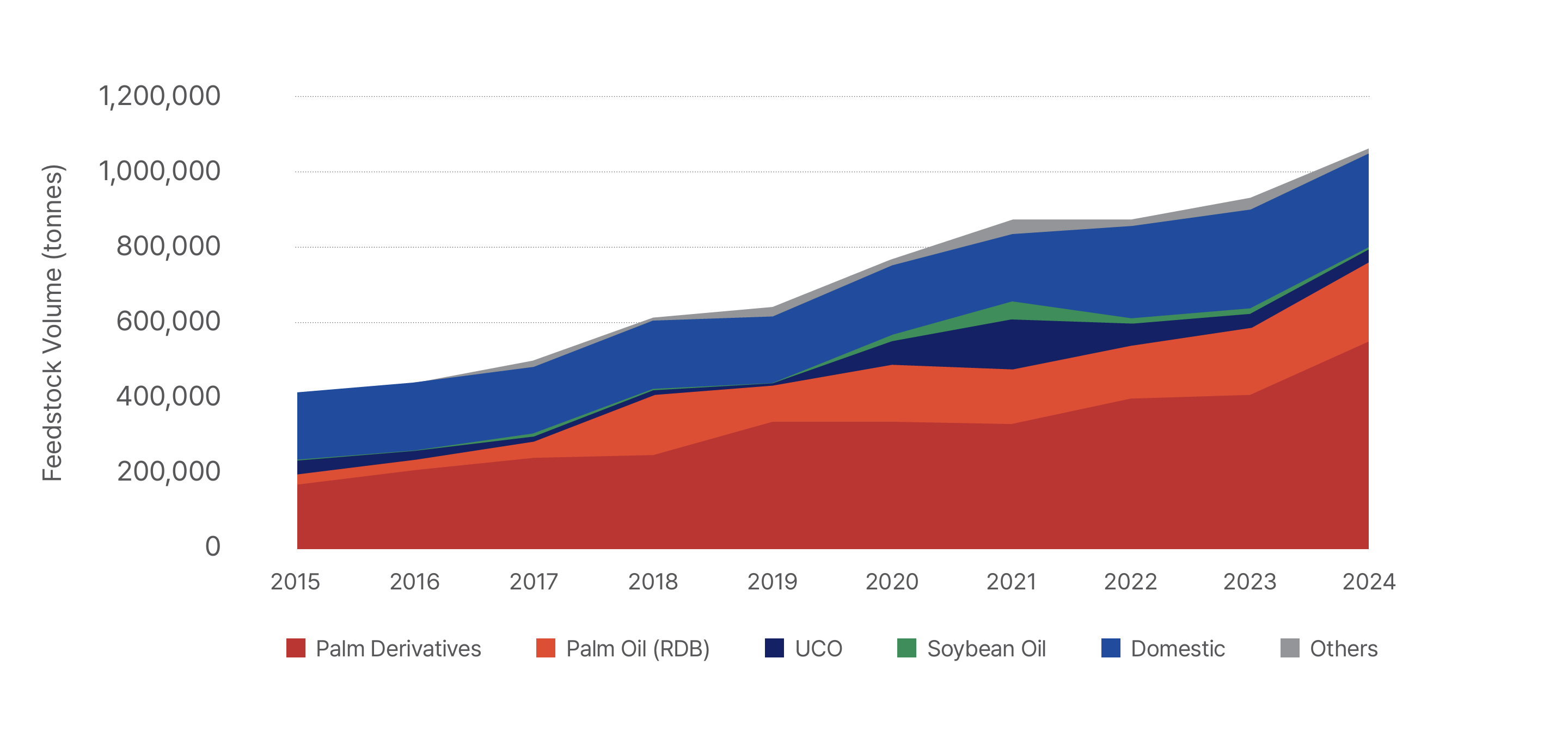 South Korea's biodiesel feedstock composition
Korean companies are expanding upstream into Indonesia’s palm oil sector. Direct investments and joint ventures involving Korean "Big Oil" are vertically integrating oil palm supply chains from plantations to biofuel refineries, shifting Korea’s involvement from simple downstream purchasing to deeper establishment within Indonesia’s resource governance.
Korea-linked supply chains remain exposed to environmental, social, and legality risks despite certification and pledges. More than 90% of export volumes are linked to documented cases of ecosystem degradation, land rights conflicts, and corruption in governance in Indonesia, underscoring weak enforcement and regulatory non‑compliance.
A quarter of Korea’s imports are from areas devasted by the 2025 Sumatra floods. Palm oil and derivatives from concessions implicated in the floods and subsequent permit revocations by the Indonesian government account for 23% of import volumes in 2025. Korea does not have any measure to address disaster-linked commodity trade.
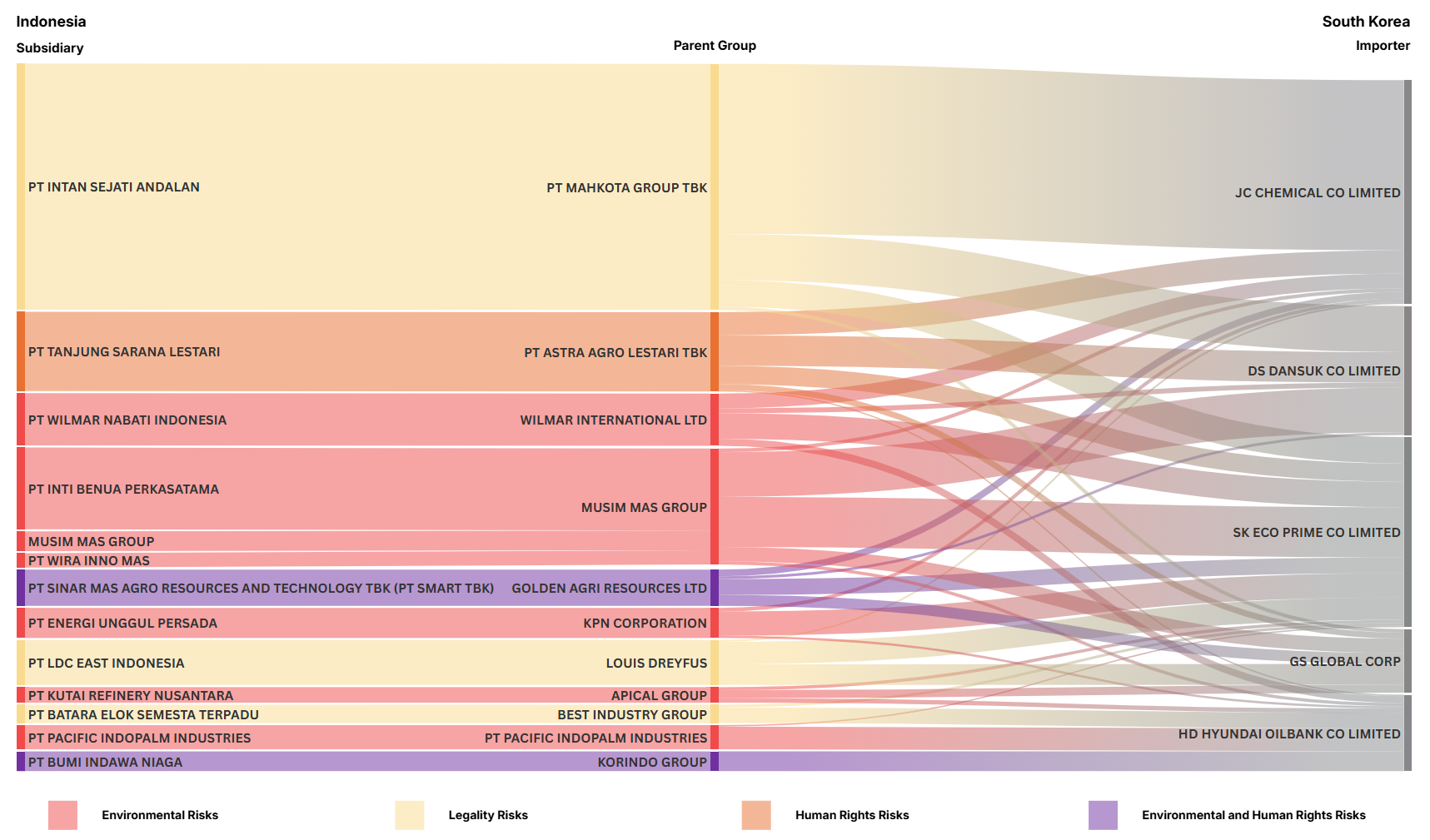 Trade flow and supply chain risks of palm oil and derivatives from Indonesia to South Korea (2023–2025)
Absent sustainability safeguards in Korea’s biofuel policy are turning the country into a leakage market. As the EU moves ahead with deforestation-free requirements, suppliers unable to meet stringent standards may divert exports to laggard countries like Korea where all biofuels are incentivized without ESG considerations.
Korean companies are enabling this unsustainable supply chain model through the lack of a zero deforestation policy. None of the identified Korean palm oil importers has a No Deforestation, No Peat, and No Exploitation (NDPE) or other deforestation-free commitments across their supply chain. Most companies lack human rights safeguards.
Related research
Sustainable Biomass Program: Certifying the Unsustainable
2025-07-31
IMO Net-Zero Framework: Fuel Cost and Carbon Price Impacts
2025-07-23

South Korea to Reduce Subsidies for Biomass Energy, Explained
2025-01-19

Unheeded Warnings: Forest Biomass Threats to Tropical Forests in Indonesia and Southeast Asia
2024-10-10

A Study on South Korea's 2050 Net Zero Pathway for Shipping
2024-09-25

Environmental Risks of Bridge Shipping Fuels and Fuel Transition Plans of South Korea, China and Japan
2024-08-12

A Climate and Biodiversity Loophole Support for Biomass Power Undermines Global Targets —A South Korea Case
2024-05-22

Subsidized Deforestation: 10 Years of Biomass Power in South Korea
2024-04-05

Mission Failed: The limitations of palm oil certifications in preventing deforestation
2023-04-13

Forest biomass: Burning the bridge to a renewable future
2022-08-26
![[Webinar] International webinar on enhancing due diligence of forest risk commodities' supply chains in Asia](https://content.sfoc.tapahalab.com/images/research/sjGudme.jpg)
[Webinar] International webinar on enhancing due diligence of forest risk commodities' supply chains in Asia
2022-04-28

Importing Deforestation: Forest-risk Commodity Supply Chains and Due Diligence Legislation in South Korea
2022-03-23

산림·생태 바이오에너지 제20대 대선 공동 정책 제안서
2022-01-25
![[토론회] 한국형 녹색분류체계(K-Taxonomy), 무엇이 녹색경제활동인가](https://content.sfoc.tapahalab.com/images/research/bn8jdme.jpg)
[토론회] 한국형 녹색분류체계(K-Taxonomy), 무엇이 녹색경제활동인가
2021-11-23

Japan-Korea International Media Briefing on Biomass
2021-10-21
![[Webinar] Palm Oil based Biofuels Policy and Socio-Environmental Impacts in Asia](https://content.sfoc.tapahalab.com/images/research/BOpldme.jpg)
[Webinar] Palm Oil based Biofuels Policy and Socio-Environmental Impacts in Asia
2021-09-12

Not Good Oil to Burn: Biofuel Policy in South Korea
2021-08-18

Can Biomass Qualify as Renewable Energy? The State of Biomass Policy in South Korea
2020-09-27

(KOR) Biomass Is the New Coal: Is Biomass Generation Truly ‘Renewable Energy’?
2020-09-27


