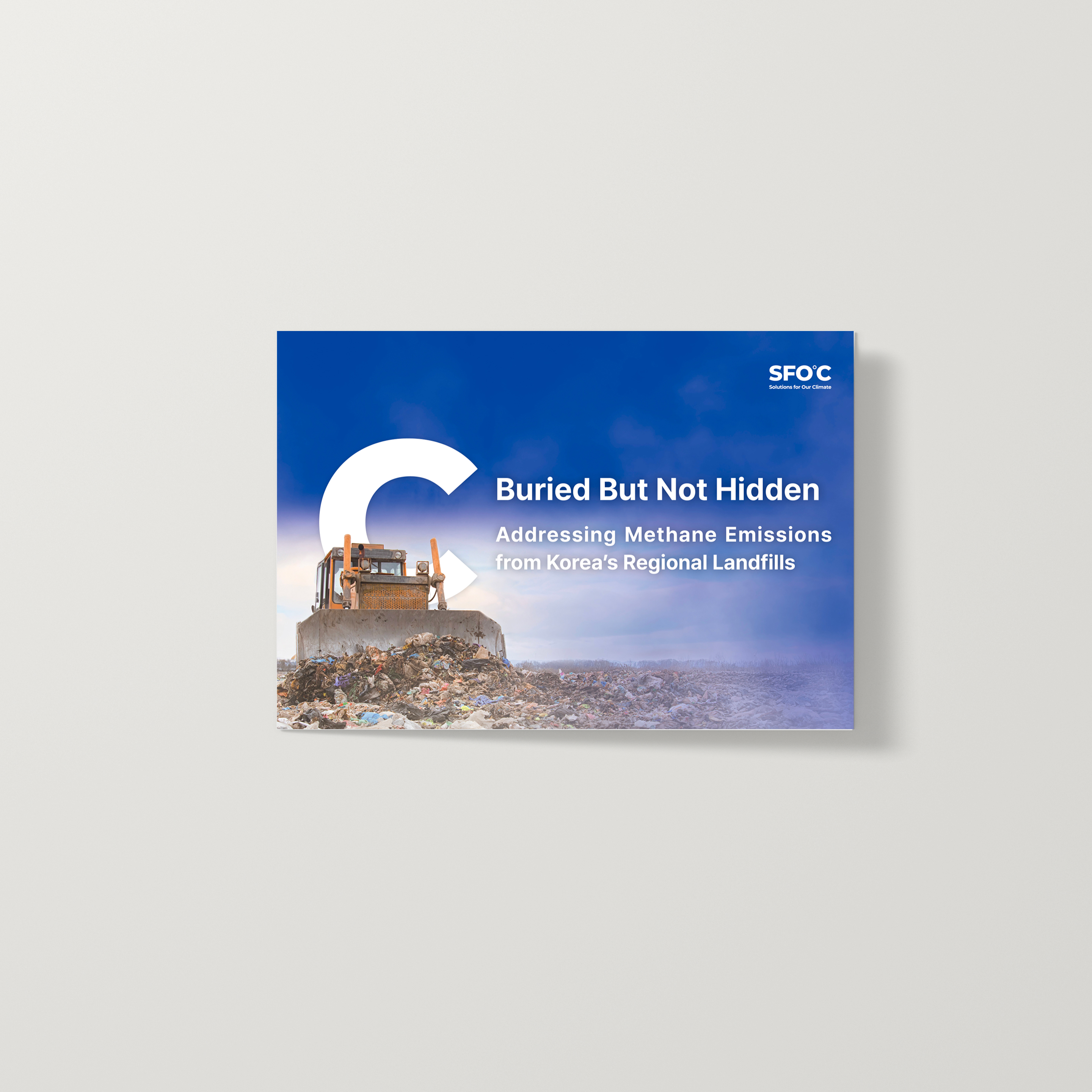
Buried But Not Hidden: Addressing Methane Emissions From Korea's Regional Landfills

About
This report analyzes why methane (landfill gas) emissions from South Korean regional landfills are poorly managed, and proposes necessary actions for effective methane emissions management.
Problems
1. Lack of Gas Capture Infrastructure: Most landfill gas generated in anaerobic landfills is released into the atmosphere as methane. While installing facilities to capture and convert this methane into energy can significantly reduce emissions, some landfills do not implement methane capture due to lack of economic feasibility, resulting in relatively high emission levels.
2. Discrepancy Between Design and Operation: Some Korean regional landfills are designed as semi-aerobic, which can reduce methane emissions compared to anaerobic landfills. However, due to inadequate on-site management, many landfills are actually operated anaerobically. This gap between design and actual operation leads to higher-than-expected methane emissions.
Recommendations
Comprehensive Government Survey: The government should conduct a full-scale inspection to identify:
The installation status of gas capture facilities in anaerobic landfills.
The feasibility of converting anaerobically operated landfills to semi-aerobic systems.
Identification of landfills that were designed to be semi-aerobical but operates anarobically in practice.
Pilot Projects for Conversion: Launch pilot programs to convert anaerobic landfills to semi-aerobic systems to assess economic feasibility and greenhouse gas reduction.
Establishment of National Roadmap: Based on pilot results, establish a roadmap to expand the conversion and standardized operation of semi-aerobic systems across all local landfills nationwide.
Related research
![[SFOC] Hidden Methane Emissions, Tangible Economic Costs: Lost Fuel Value and Heatwave-Related Climate Damages from Korea’s Imported Fossil Fuel Supply Chains](https://content.forourclimate.org/images/research/yUNyzaf.jpg)
[SFOC] Hidden Methane Emissions, Tangible Economic Costs: Lost Fuel Value and Heatwave-Related Climate Damages from Korea’s Imported Fossil Fuel Supply Chains
2026-08-03
Hidden Methane Emissions, Tangible Economic Costs: Lost Fuel Value and Heatwave-Related Climate Damages from Japan’s Imported Fossil Fuel Supply Chains
2026-08-03
Asia Waste Methane Comparative Analysis Study
2026-06-05
The Changing Legal Landscape for LNG Shipping Expansion
2026-01-08
No Budget, No Cuts: Budget and Methane Reduction Impact Analysis for Achieving 78% Low-Methane Feed Supply Target
2025-12-03
No Budget, No Cuts: Agriculture’s 2030 NDC Targets at Risk
2025-09-16
Unlocking Solutions: The Social Benefits of Reducing Methane Emissions from South Korea’s Energy Imports
2025-07-30
Assessment of Opportunities for Implementing a Methane Import Standard in South Korea
2025-06-30

From Manure to Methane: Uncovering Hidden Emissions in Livestock Manure Treatment
2025-04-28

Korea's Upstream Challenge: Mitigating Global Methane Emissions
2024-11-15

Ensuring Korea’s Methane Mitigation Efforts are 1.5-degree Aligned
2024-11-11

EU Methane Import Standard: Policy Implications for South Korea
2024-09-09

Methane Leaks from Buried Food Waste
2024-07-31

LNG運搬船: 世界のガス取引を拡大させる海上パイプライン ――影の推進者を明らかにする
2024-06-12

Industry Trends Brief No.2 - Unmasking the Hidden Culprit Beyond CO2: Methane
2023-05-31
![[Report] Methane Reduction Strategies and Regulations in South Korea: Current Issues and Policy Recommendations](https://content.sfoc.tapahalab.com/images/research/xxJgdme.jpg)
[Report] Methane Reduction Strategies and Regulations in South Korea: Current Issues and Policy Recommendations
2023-02-22


