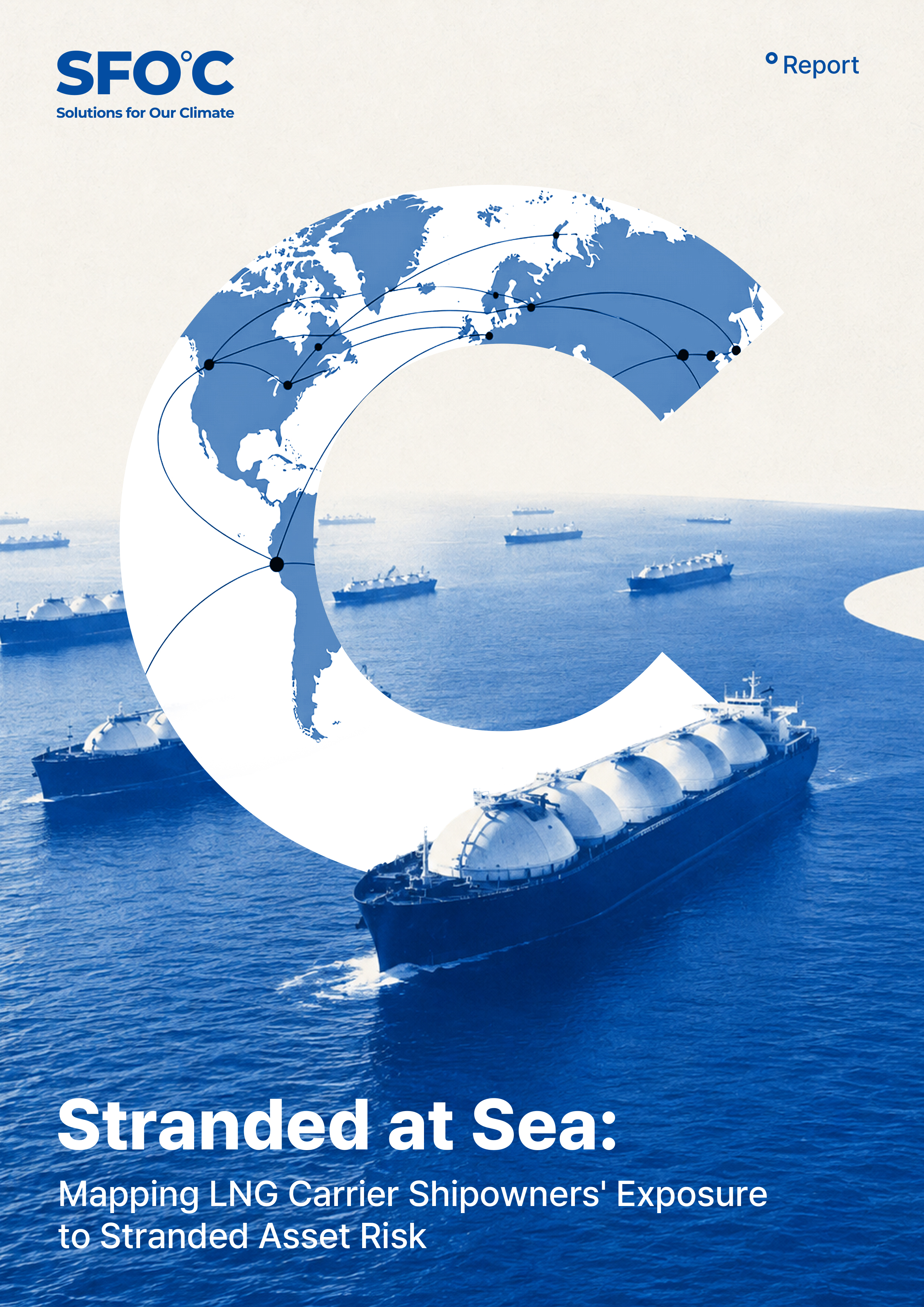
Stranded at Sea: Mapping LNG Carrier Shipowners’ Exposure to Stranded Asset Risk


About
This report examines who owns the expanding LNG carrier fleet, how exposed these companies are to stranded assets, and what shipowners, financial institutions and insurers can do about it. Using commercial fleet and charter data from mid-September 2026, it maps all 1,111 large LNG carriers (100,000 cbm or more) in service and on order to 125 owner groups, and profiles 31 groups in depth. For each group it looks at fleet growth, idle ships, visible charter cover and working lives beyond 2050. Building on SFOC’s research on LNG carriers since 2023, it moves the focus from the market to the owner. It is written mainly for shipowners, and also for the banks, lessors, export credit agencies and insurers that finance and insure their fleets.
Download report
Executive summary
The closure of the Strait of Hormuz since late February 2026 has shaped the year for LNG shipping. It cut off almost a fifth of global LNG supply and briefly lifted charter rates, yet by early October spot rates had fallen 83–91% from their wartime peaks. The resulting jump in gas prices has also hit demand. In Asia, importers have canceled or reconsidered LNG projects, and IEEFA forecasts that European LNG demand could fall about 23% between 2025 and 2030. The war has delayed the fleet’s surplus, not removed it.
Owners are still adding ships. The large LNG carrier fleet has grown from at least 335 vessels in 2016 to 833 today, and a further 278 are on order, about US$69 billion of committed capital. Under the IEA’s net-zero pathway, no new LNG carriers are needed at all. This report finds that stranding has already begun, that exposure is concentrated in a small number of owners, and that more than half of the capacity in service and on order will still be within its design life after 2050.
Owners and financiers who plan now for a smaller LNG fleet will protect more of their asset value than those who keep adding capacity to an oversupplied market. The report calls on:
Shipowners to avoid speculative newbuilds and order only against long-term charters, test fleet values against a 25-year economic life and climate-aligned demand, share charter cover and useful-life assumptions vessel by vessel with lenders and investors, and set out how their LNG fleet will peak and decline
Banks, lessors and export credit agencies to match loan tenors to firm charter cover, report their LNG carrier exposure, and test whether public guarantees for new LNG carriers are consistent with their climate commitments and risk appetite
Marine insurers to reflect transition risk in hull and machinery pricing, and use annual renewals to discuss clients’ transition plans, including fleet age and utilization
Key findings
Oversupply is already committed. The large LNG carrier fleet (100,000 cbm or more) grew from at least 335 vessels in 2016 to 833 today, and its capacity from 54.1 to 140.9 million cbm. A further 278 vessels (51.1 million cbm, 36% of today’s capacity) are on order, 237 of them delivering in 2027 or later. Independent analysts project a surplus of 110–200 vessels.
Stranding is already under way. 78 vessels (9.4% of the fleet, 13.0 million cbm) are idle or laid up. A quarter of the 186 steam turbine carriers are not trading, 4.7 times the rate for other ships. The average LNG carrier scrapped in 2025 was 26 years old, against the 35–40 years owners and lenders often assume. The 2026 Gulf war has idled more ships, but the steam pattern predates it: leaving out the 27 idle ships tied to Qatar’s trade, steam turbines are ten times as likely as other ships to be idle or laid up.
Exposure is concentrated in a few owners. Ten owner groups hold 43.7% of capacity in service and 45.0% of capacity on order. The five largest orderbooks, held by Nakilat, Mitsui OSK Lines, China Merchants, NYK Line and ADNOC, account for 36.3% of all capacity on order.
Charter cover is largely invisible. Only 174 of 833 vessels (21%) have a forward charter expiry on public record, and 84% of those end by 2035. For about four ships in five, the dataset used for this analysis records no forward charter expiry.
The 2050 trap: run the ships, or write them off. On a 30-year design life, 55% of capacity in service and on order is still in its working life after 2050. On the 38-year average lifespan used in the Investment Risk Monitor, the share is 78%. Either these ships lock in emissions beyond shipping’s net-zero target date, or they retire early and the capital is written off. The orderbook alone represents about US$69 billion of committed capital.
Related research
Off the Books: Financed Emissions from South Korea's Public Finance for Overseas Fossil Fuel Projects
2026-10-19
[SFOC] Hidden Methane Emissions, Tangible Economic Costs: Lost Fuel Value and Heatwave-Related Climate Damages from Korea’s Imported Fossil Fuel Supply Chains
2026-08-03
Hidden Methane Emissions, Tangible Economic Costs: Lost Fuel Value and Heatwave-Related Climate Damages from Japan’s Imported Fossil Fuel Supply Chains
2026-08-03
KEPCO’s Financial Risks: When State-Owned Utilities Become an Economic Drag
2026-07-23
The Undisclosed Bill: How Hyundai Motor Group is accruing a CBAM liability it has not quantified for investors
2026-07-15
Status of the National Pension Service’s Stewardship Activities and Recommendations for a Climate Stewardship Code
2026-07-06
Steel in the Portfolio: An Engagement Framework for Institutional Investors
2026-06-16
Korea's LNG Expansion Paradox: Declining Demand, Growing Infrastructure
2026-06-10
Solving the Renewable Energy Disconnect: Enabling Korea’s 100GW RE Target Through Priority Grid Connection Policy
2026-06-01
Stewardship Without Climate : Reforming Korea’s Stewardship Code
2026-05-13
An Assessment of Environmental and Social Impacts of LNG Carriers
2026-04-06
Recurring Crisis, Delayed Transition: From Fossil Fuel Dependence to Energy Independence
2026-03-18
Shipping Decarbonization Continues: South Korea's Choices amid IMO Delay
2026-03-04
Empty Seats at the Climate Table : Board Oversight Gaps in Hyundai Motor Company's Climate Governance
2026-03-03
Reforming South Korea's Power Sector: Setting the Stage For the Renewable Energy Transition
2026-02-04
The Changing Legal Landscape for LNG Shipping Expansion
2026-01-08
Why LNG Reduction Matters: Redefining Energy Security and Unlocking Economic Gains
2025-12-08
Settled in Secret: The Opaque Grid Fee System Undermining Renewable Energy PPA Expansion in South Korea
2025-12-01
From Words to Data: Bridging Hyundai’s Climate Commitments and Disclosure
2025-11-28
South Korea’s Export Credit Finance in Transition: National Economic Impacts of the Global Shift from Fossil Fuels to Clean Energy
2025-11-16
Exposed: Overcompensation of KEPCO's Coal Fired Power Plants
2025-11-10
Global Top 100 Shipping Companies by Environmental Performance(2025) - Is Korea’s Shipping Ready for the Net-Zero Era?
2025-11-04
Supplementary Brief: South Korea's Exposure to Shipping Stranded Asset Risks
2025-10-26
VPPs: The Key to Korea's Transition to a Renewable Energy-Based Power System
2025-08-28
Bridge to Nowhere: The Doomed Fate of Korea's LNG Terminals
2025-08-19
The Climate Crisis—Culprits and Liability: Contribution of South Korea’s Top Ten Emitting Corporates to Climate Loss & Damage
2025-08-10
Accelerating Renewable PPAs in South Korea: 2025 Regulatory Updates and Unresolved Challenges
2025-08-06
Speed Bumps on the Renewable Energy Highway: Minimum Generation Levels of Thermal Power Plants
2025-08-05
IMO Net-Zero Framework: Fuel Cost and Carbon Price Impacts
2025-07-23

Can the Korean Semiconductor Industry Meet its Renewable Energy Targets? Policy Recommendations
2025-06-24

No Room for More: Why LNG Carriers Are a Climate and Financial Risk
2025-05-13

Analyzing Korea’s 2035 NDC GHG Emissions Reduction Pathway through an Integrated Assessment Model
2025-04-23

Charting a Net-Zero Pathway: A Korea-Europe Green Shipping Corridor Linking Pyeongtaek and Key European Ports
2025-04-22

Capitalizing on Coal: How Global Investors and Underwriters Enable KEPCO to Abandon the Sustainability Path
2025-03-20

Moving Away from Coal: 2025 POSCO Holdings Climate Risk
2025-03-17

Green Premium - Out of Synch with Global GHG Protocol Standards
2025-02-16

Stronger Together: Unlocking Community Power for Lasting Change
2025-02-04

Missing points of “South Korea’s East Sea Blue Whale Project”
2025-01-08

Socio-economic Impacts of Energy Transition in Chungcheongnam-do
2024-12-18

Bridging the Nature Finance Gap: Aligning South Korean Banks with the Global Biodiversity Framework
2024-10-27

Still Adrift: Updated assessment of the global energy transition's impact on the LNG shipbuilding industry
2024-10-14

South Korea's PPA System: Status and Opportunities for Renewable Energy Development
2024-10-10

A Study on South Korea's 2050 Net Zero Pathway for Shipping
2024-09-25

Billions Off Course: Japan's Oil and Gas Financing Fueling the Climate Crisis
2024-09-05

Floating Doubt: The Risks of FSRUs in Expanding Methane Gas
2024-09-03

Environmental Risks of Bridge Shipping Fuels and Fuel Transition Plans of South Korea, China and Japan
2024-08-12

Issues with Fossil Fuel-Based Yongin National System Semiconductor Industrial Complex
2024-07-31

Limitations of LNG in the Shipping Decarbonization
2024-07-31

Improving the Governance of the Power System to Scale Up Renewables
2024-06-13

LNG運搬船: 世界のガス取引を拡大させる海上パイプライン ――影の推進者を明らかにする
2024-06-12

Reconsidering Korea's LNG Bunkering 100% Rebate Policy
2024-06-04

Three Unseen Flaws of the Boryeong Blue Hydrogen Project in South Korea
2024-05-26

Threat of Toxic Substances: Increased Particulate Matter and Health Hazards from Ammonia Co-firing
2024-05-22

[Brief] South Korea’s international public finance continues to block a just energy transition
2024-04-02

[Report] Achieving Net Zero in International Shipping through Korea-US-Japan Green Shipping Corridor
2024-02-13

Total Turmoil: Unveiling South Korea's Stake in Mozambique's Climate and Humanitarian Crisis
2024-01-29

LNG Carriers: The Floating Pipeline Powering Global Gas Expansion - Unveiling its Hidden Enablers
2023-11-27

Current Issues in KPX’s Governance and Policy Proposal for Sustainable Change
2023-11-22

Industry Trends Brief No.3 - Port Decarbonization: Focusing on South Korean Five Major Ports
2023-09-15

[Report] Financing a Paris-Aligned Coal Exit in South Korea
2023-06-01

High and dry:The global energy transition's looming impact on the LNG and oil shipbuilding industry
2023-05-24

Betting on a Sinking Ship: Banks Behind the Barossa Gas Field’s FPSO
2023-04-18

Clean power in South Korea: A roadmap to zero fossil gas in South Korea’s power sector
2023-03-27

Korea's Green Shipping Pathways: The Korean Shipping Landscape and Policy Recommendations for Ocean-Climate Leadership in Shipping
2022-12-09

에너지 안보와 탄소중립을 위한 공정한 전력시장 발표자료집
2022-11-25

[Consultation Brief] No Room for New Gas in South Korea
2022-11-22

Jeju's 2030 Carbon-Free Vision Begins With Renewable Curtailment Freedom
2022-09-22

Unbalanced Power Market: Analysis of how market structures discriminate against demand response in favor of gas power generation
2022-09-20

Unveiling Fossil Greenwashing: Hidden Emissions of Korea's Hydrogen Scheme
2022-09-13

[이슈브리프] 한전 적자 부추기는 전력시장 보상제도와 거버넌스
2022-08-24

Accelerating Corporate Renewable Electricity Procurement in Korea
2022-08-01

[ISSUE BRIEF] Fossil Fuels, the Main Culprit behind KEPCO’s Deficit
2022-06-03

Transforming the Korean Power Market to Reduce Renewable Curtailment
2022-05-03

[Issue Brief] Assessment of Climate Change Policies of Major South Korean Financial Institutions
2022-01-04

RE100 Scheme Left Stranded, with Focus on High Network cost and Unreasonable Guidance on Trilateral PPAs
2021-12-23

[이슈 브리프] 좌초되는 한국형 RE100 제도: 망이용료와 제3자 PPA를 중심으로
2021-12-14

[토론회] 한국형 녹색분류체계(K-Taxonomy), 무엇이 녹색경제활동인가
2021-11-23

Bridge to Death: Air Quality And Health Impacts of Fossil Gas Power
2021-11-19

[이슈 브리프] 탄소포집, 이용 및 저장기술(CCUS) 현황과 문제점
2021-11-03

KR-DE Road to 2050 : Financing Clean Energy Transition
2021-09-28

Fueling the Climate Crisis_South Korea's Public Financing for Oil and Gas
2021-08-31


